
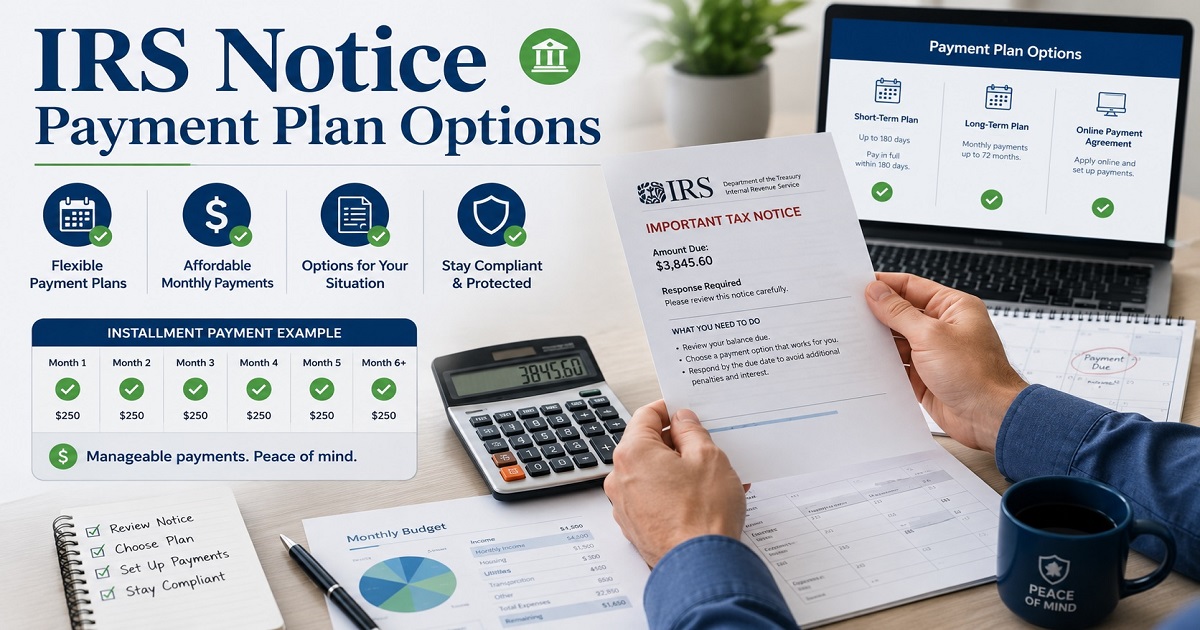
As pointed out by Advocate Shahid (Tax Analysis and Advisory Specialist). There are three major IRS Notice Payment Plan Options: short term (up to 180 days) for temporary relief, long term installment agreements (up to 72 months) or payment options for financially distressed taxpayers, such as an Offer in Compromise (OIC). There are set-up fees; the fee may be reduced or waived for qualifying low-income tax payers.
1. Short-Term Payment Plan
What Are IRS Notice Payment Plan Options?
The main IRS notice payment plan choices consist of:
- Pay the balance in full at once!
- Enter into an IRS payment plan | IRS payment plan
- Submit an application to the IRS for a long-term installment agreement. Do a long-term IRS installment agreement application.
- If you are unable to use the online application, use Form 9465.
- If you can’t pay in full request a partial payment installment agreement.
- Request “currently not collectible” if you are unable to pay due financial hardship
A short-term payment plan will allow eligible individual taxpayers as much as 180 days to pay, and a long-term plan will allow for monthly payments under an installment agreement, the IRS says. Taxpayers can apply online, provide the IRS by mail on Form 9465 or via telephone on the IRS number on the balance due notice.
What an IRS Notice Payment Plan Means
An IRS payment plan is an arrangement between the IRS and the taxpayer, which lets the taxpayer make a federal tax debt over time rather than paying it in full when it is due from the IRS. These IRS notice payment options may be helpful in situations where the IRS sends a taxpayer a notice or letter indicating an IRS amount due, unpaid taxes, penalties and interest.
IRS payment plan (short-term or long-term). A long-term plan is also known as an IRS monthly payment plan or installment agreement. The IRS tax payment options are geared toward taxpayers who are unable to pay a complete tax bill from the IRS today but would be able to pay the tax obligation over time. According to the IRS, a payment plan is a settlement to pay the taxes owed over a longer period of time.
Real-Life Example
The IRS notifies a self-employed taxpayer that their account is due for $7,800.The IRS sends self-employed taxpayer a CP14 balance due notice. They do not want to pay off their total bill before the deadline, so they log into their online IRS account, make sure the amount is correct and request an IRS online payment plan. The IRS says that when the IRS sends a CP14 notice, the taxpayer is behind on their taxes and is supposed to pay the taxes, set up a payment plan, or discuss their disagreement with the IRS.
Common IRS Notices That May Lead to a Payment Plan
IRS Notice CP14
IRS Notice CP14 is one of the initial balance due notices. It informs the taxpayer that they have unpaid taxes to pay, should pay, and should provide a plan for paying the taxes or reach out to the IRS if they have a reason for not agreeing with the amount of taxes. This notification may be the first time taxpayers consider their choices on how to pay their IRS notice.
IRS Notice CP501
The IRS Notice CP501 is typically a reminder notice for an unpaid balance. It indicates that the IRS hasn’t received payment or a response to an earlier notice. The taxpayer should take it seriously as a tax debt notice at this stage, and should be ready to make a payment if they have decided to have a payment arrangement with the IRS; before the account reaches further stages in the IRS tax collection process.
IRS Notice CP503
The IRS Notice CP503 is a greater reminder that the IRS has yet to receive payment. The IRS states that if the taxpayer doesn’t pay, make payment arrangements, or reach out to IRS, it might place a Notice of Federal Tax Lien. A tax lien becomes a public notice when IRS has a legal claim to a taxpayer’s property.
IRS Notice CP504
The IRS Notice CP504 is a serious notice. It is a Notice of Intent to Levy, which means that the IRS will be able to place a levy on wages, bank accounts or a state tax refund since the taxpayer has an outstanding balance. This can result in IRS collection activity such as a tax levy, bank levy or wage levy (also referred to as wage garnishment, by taxpayers).
CP521 Installment Agreement Reminder
The CP521 is distinct as it typically comes after a taxpayer already has an installment agreement. As a reminder to the taxpayer about payment of their monthly installments. Penalties and interest can be raised if the taxpayer fails to timely pay the debt and they could default on the installment arrangement.
IRS Notice Payment Plan Options Explained
Option 1 — Pay in Full
It is best to pay off the loan as soon as you can if you’re able to. It can help reduce the amount of accrued interest, the late payment penalty and the failure to pay penalty since the penalties from the IRS may continue until the balance is paid.
Option 2 — Short-Term IRS Payment Plan
If you can pay the entire IRS debt within 180 days or less, then a short-term payment plan may be a viable option following notice. When you are unsure what to do about IRS notice if I can’t pay, then this can be a possibility. People might be eligible online to obtain a short-term payments program in the event they owe less than $100,000 for a combined tax, penalties and interest. No set-up fee, but penalties/interest will still be charged until the loan is repaid.
Option 3 — Long-Term IRS Installment Agreement
There are a number of long-term payment plans, also known as IRS installment agreement after notice, that offer monthly payments. If taxpayers have owed less than $50,000 and have filed all required returns, they can apply online for a long term IRS payment plan after they are notified.
Option 4 — Direct Debit Installment Agreement
A direct debit installment agreement is a payment agreement that is automatically deducted from your bank account. It reduces the chance of late payments and it can be controlled via the Online Payment Agreement system.
Option 5 — Form 9465 Payment Plan Request
If you are unable to file online, use IRS Form 9465 (payment plan request). Form 9465 is for applying for a monthly installment arrangement of tax due on a tax return or IRS notice.
Option 6 — Partial Payment Installment Agreement
If you can make monthly payments but not the full amount before the Collection Statute Expiration Date, you can enter into a partial payment installment agreement. Financial documentation might be necessary.
Option 7 — Currently Not Collectible Status
If unable to pay anything for hardship, currently not collectible status might be helpful. The IRS might ask for a Collection Information Statement, including Form 433-F, Form 433-A or Form 433-B. The debt will not be forgiven and there will be penalties and interest.
Step-by-Step Solution: How to Set Up an IRS Payment Plan After a Notice
Step 1: Read the IRS Notice Carefully
Look at notice number, tax year, IRS amount due, payment due date, penalties and interest, appeal and response date.
Step 2: Verify the Balance
Check the notice against the IRS Online account, tax return, payment record, IRS Direct Pay confirmation and bank records.
Step 3: Decide Which Payment Plan Fits
| Situation | Best Option |
|---|---|
| Can pay within 180 days | Short-term payment plan |
| Need monthly payments | Long-term installment agreement |
| Cannot apply online | Form 9465 |
| Cannot pay full balance before collection deadline | Partial payment installment agreement |
| Cannot pay anything now | Currently not collectible |
Step 4: Apply Online
For those considering IRS IRS payment plan online, you can apply for IRS payment plan online through online IRS notice payment agreement. Taxpayers may apply online without making a call, mailing or visiting the IRS office, the IRS says. This type of IRS payment plan application is typically the quickest way to pay the IRS.
Step 5: Use Form 9465 If Needed
If it’s not possible to submit the payment plan request online, or you prefer to submit it by mail, you’ll need to use Form 9465.
Step 6: Choose a Monthly Payment You Can Actually Afford
Avoid selecting a high payment to be approved for rapidly. Failure to pay on time may jeopardize your agreement.
Step 7: Stay Current With Future Taxes
Continue to file and pay future tax returns and future taxes on time during a payment plan.
Step 8: Monitor IRS Notices After Approval
A reminder of an installment agreement (CP521) is a notification that you must pay your installment agreement. If IRS plans to terminate the installment agreement, they will likely send you a CP523 notice, which will state that they will proceed with the levy if you don’t take action.
Problems Taxpayers Face After Receiving an IRS Payment Notice
Problem 1: “I Can’t Pay the Full Balance”
The solution: Get a short-term or long-term IRS payment plan. If you can pay, you might want to consider using a short term plan; an installment agreement is an option to pay each month over time.
Problem 2: “The IRS Balance Looks Wrong”
Solution: Review your IRS online account, tax return, IRS payment records, IRS Direct Pay confirmation and bank statements. If this still does not seem correct, call the IRS on the number provided on the notice.
Problem 3: “Penalties and Interest Are Growing”
Solution: Make as much payment as possible in advance and then work out a realistic repayment plan. Typically, the IRS will not cease interest payments as long as taxes are not paid and interest may accrue until the total debt is repaid.
Problem 4: “I Missed a Payment”
Solution: You should report to IRS immediately. If your financial situation has altered, the IRS says that you might be able to have your monthly payment lowered, but you may need some proof of your financial change.
Problem 5: “I’m a Business Taxpayer”
Solution: Although payment options may exist for business taxpayers, the rules could vary depending on the type of tax and business structure. Generally, sole proprietors and independent contractors submit their returns as individuals; however, business taxpayers may be required to obtain the number from the notice or the IRS business line.
Real Case Laws
Case Law 1: Goza v. Commissioner
Goza v. Commissioner should be read to help with understanding Collection Due Process cases. The Tax Court typically reviews the IRS collection action for abuse of discretion, as opposed to a second examination of the underlying tax liability, if the underlying tax liability is not properly under consideration. Also Goza is referenced for the IRS CDP rule that a taxpayer can’t later dispute the liability if they had an earlier opportunity to dispute it.
Content lesson:
Avoid delaying resolution of issues until IRS collection activities begin.
Case Law 2: Orum v. Commissioner
Orum v. Commissioner sheds some light on defaulted installment agreements. If so, the taxpayers signed an installment agreement, but failed to make all the monthly payments and the agreement was cancelled.
Content lesson:
If the taxpayer doesn’t stick to the terms of the payment plan, the IRS won’t keep him or her safe.
Case Law 3: Giamelli v. Commissioner
In Giamelli v. Commissioner, the Court illustrates the importance of “keeping up with the times.” The court concluded that the IRS was not unreasonable in denying an installment agreement when the taxpayer didn’t pay the estimated tax.
Content lesson:
It’s important for a taxpayer to keep up with future tax liabilities as they work toward resolving past tax debt.
Case Law 4: Murphy v. Commissioner
Murphy v. Commissioner is an example of how deadlines and documentation are important in IRS collection proceedings. Since the taxpayer failed to comply with the deadlines and provided no information, there was no abuse of discretion in the IRS’ decision to discontinue the CDP hearing, the court determined.
Content lesson:
When the IRS requests financial data, provide it in a timely manner and maintain documentation of the information furnished.
Real Case Studies
Case Study 1: Individual Taxpayer With CP14 Notice
Individual taxpayer gets a CP14 notice that IRS is owed $5,200. They can’t afford the total amount in one lump sum before the deadline but can afford to pay it within a few months time. They go online to their IRS account, and find the balance of their taxes is correct; then they apply for a short-term plan and settle for the total within 180 days.
Case Study 2: Self-Employed Taxpayer With $28,000 Balance
If a freelancer underpays quarterly estimated taxes, he or she will get an IRS balance due notice. They are unable to pay $28,000 in one lump. Unable to pay in one big shot, they seek an IRS agreement that pays over a long period of time. They select direct debit payments as this means that the amount they need to pay is deducted from their bank account each month, helping to avoid the chances of late payments.
Case Study 3: Small Business Owner With Payroll Tax Stress
A small business owner is sent a notice of collection for unpaid business taxes by the IRS. They don’t have the funds to pay the balance in full and contact a CPA for IRS payment plan information or an enrolled agent for IRS tax debt assistance. They check the financial forms and look at the options of payment before it goes much further in the collection process.
Case Study 4: Low-Income Taxpayer With Hardship
A taxpayer can’t pay rent, utilities, food and basic living expenses and pay the IRS. In this case, they could inquire about currently not collectible or a partial payment installment agreement. These may be appropriate if it would cause undue hardship to make payments each month.
What I’ve Seen Taxpayers Get Wrong With IRS Payment Plans
The most common error in an IRS notice case is not getting the notice. The actual issue is of delaying too long, opting for a monthly payment that the tax payer cannot afford, or not following an IRS letter after the plan is executed.
Taxpayers should always check the balance before establishing a payment plan with IRS. Review IRS online account, tax return, records of income/tax payments, bank statements and IRS Direct Pay confirmation. This will help establish that the balance, penalties and interest are accurate.
Taxpayers should also ensure that they don’t ignore CP14, CP501, CP503, or CP504 notices. The letters can indicate that the IRS is taking the account more toward collection action and delay may make it more difficult to remedy the situation.
A second common error is selecting the payment amount that is a pretty number, but not a realistic number. The only way a payment plan can work is if the taxpayer can pay off one month and not fall behind on filing new tax returns or getting caught up on future tax payments.
The wiser way is this: check the balance, select a payment plan that is not too expensive, keep receipts of all payments, save all IRS letters and keep up to date on any new tax obligations.
Mistakes to Avoid After Receiving an IRS Notice
Upon receipt of an IRS notice letter, here are some common mistakes that should be avoided:
- Failure to respond to the notification letter from the IRS before the date.
- Allowing the notice of a tax levy or bank levy to be received, which may make the situation worse.
- Not considering an option of a short-term plan, a long-term installment agreement, or a hardship option before signing the incorrect payment plan.
- Not realising that any penalties and interest can still be incurred if the balance is not paid off. The longer the payment terms the higher the total costs.
- Failing to make monthly payments, this can jeopardize the agreement. IRS guidance indicates that installment agreements can be cancelled if taxpayers don’t pay the required amounts.
- Failing to review the IRS’ online account to ensure the balance, payment history and notice information are correct.
- Not filing tax returns, as generally taxpayers have to be up-to-date on tax filing and payment to be eligible for a payment plan.
- Failure to use Form 9465 where it is not available online. The IRS indicates that Form 9465 is filed for monthly installment agreements when you are not able to pay the entire balance of a return or IRS notice.
- Failure to pay estimated taxes, particularly for freelancers, business owners and independent contractors.
- Failure to obtain professional assistance where the imbalance is significant and/or notice is unclear.
For high amounts or when collections have begun, consider IRS payment plan help, IRS notice help, IRS tax notice assistance, tax debt payment plan help or IRS installment agreement help. A CPA, enrolled agent, IRS payment plan attorney or tax attorney for IRS notice can help with IRS payment plan problems via IRS payment plan services, tax resolution services or Internal Revenue Service (IRS) tax relief services.
When to Get Professional IRS Payment Plan Help
When the tax notice becomes more complicated, professional IRS payment plan assistance might be necessary. For those who have a balance greater than the IRS online payment agreement threshold, several tax years involved or are unable to easily establish a balance, a CPA, enrolled agent, tax attorney, or tax resolution services provider might be able to assist you in determining the option that is right for you.
If you’ve received a CP504 notice, the IRS says it will use a levy, such as a state tax refund, your bank account or your wages to collect the remaining balance if you don’t work it out, you may need help.
It is particularly important to get professional help when you have a tax lien, tax levy, wage garnishment or bank levy. The response to these collection actions may be to income, bank accounts, and property, making it important that it be accurate and timely.
FAQs
1. What are IRS notice payment plan options?
The IRS offers a variety of payment plan types, including a short-term payment plan, a long-term installment payment plan, a partial payment installment plan and the currently not collectible option, in addition to a full payment.
2. Can I set up a payment plan after receiving an IRS notice?
Yes. If you are unable to pay the amount indicated on your IRS notice, you could complete an application electronically, over the phone or using Form 9465. Taxpayers who can’t file online might still have the option to pay over time, according to the IRS.
3. How do I apply for an IRS payment plan online?
The IRS Online Payment Agreement system can be used to apply.
4. What is the difference between short-term and long-term IRS payment plans?
A short term payment plan normally provides eligible taxpayers with up to 180 days to pay off the tax debt.
5. Does an IRS payment plan stop penalties and interest?
No, not completely. Interest and (typically) some penalties typically still continue until the balance is paid.
6. Can I get an IRS payment plan if I owe more than $50,000?
Maybe, but perhaps you won’t be eligible for the easy online process. May have to submit financial information or work directly with the IRS.
7. What IRS form do I use for a payment plan?
If you are unable to pay the total amount due, and want to request a monthly installment plan, use Form 9465, Installment Agreement Request.
8. What happens if I miss an IRS payment plan payment?
The IRS can assume the agreement is in default, and may make a proposal for termination.