
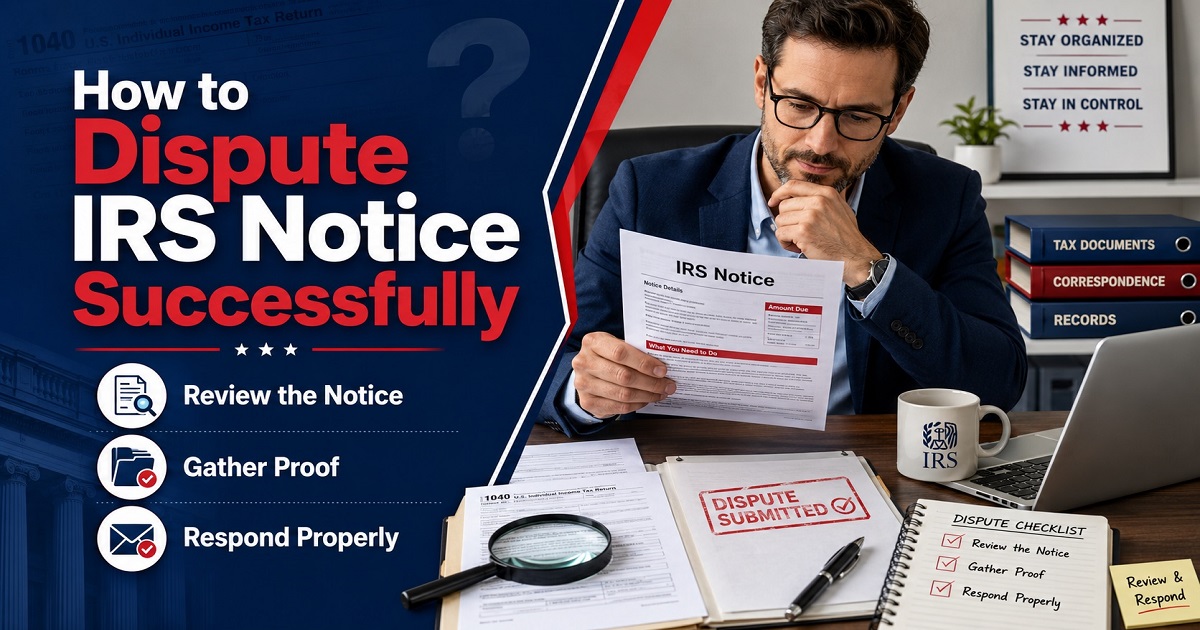
The important thing to remember if you want to challenge your IRS notice is to do so right away and do it according to the instructions included in your letter. Make sure that you have all the necessary paperwork, prepare a detailed written explanation and send it before the specified date.
How to Dispute IRS Notice Successfully: Step-by-Step Solution
1 — Read the IRS Notice Carefully
As stated by Advocate Shahid (Tax Consulting and Research Specialist). Carefully read through the IRS tax notice. Locate the CP or LTR number, tax year, the amount owed, proposed changes, the IRS response period, address to which they will send the letter, fax number, and any appeal rights.
2 — Compare the Notice With Your Tax Return
Look at a copy of your tax return, your W-2s, your 1099s, your deductions, your credits, your income, your AGI, your refund, your tax payment and your amended tax return or Form 1040-X.
3 — Check Your IRS Online Account and Transcript
Check your IRS account balance, tax payment history, tax payment confirmation, adjustments, penalties and amended return activity in your IRS online account and tax account transcript.
4 — Gather Proof
Handy documents are the IRS notice, tax return copy, IRS transcript, bank statement, cancelled check, payment confirmation, corrected W-2, corrected 1099, Form 1040-X, Form 843 and prior IRS letters.
5 — Write a Clear IRS Dispute Letter
State that you do not agree with the notice and note the number and year, specify the error, include attached documentation, ask that the error be corrected, and sign the letter. Do not send originals, send copies.
6 — Send the Response Correctly
Send the answer to the IRS address in their notice by mail or by fax. Send by certified mail or other means that could be tracked with copies.
7 — Request Penalty Abatement
When penalties are incorrect or if eligible, appeal for reasonable cause relief, First Time Abate, or other type of penalty abatement.
8 — Appeal If Needed
If the IRS denies your appeal, check your option for IRS appeal rights, IRS Form 12203 or reconsideration.
9 — Get Professional Help
Call a CPA, enrolled agent or tax attorney for audits, CP504 notices, high dollar balances, Tax Court deadlines, payroll tax issues, or fraud issues.
Can You Dispute an IRS Notice?
Yes, you are allowed to file IRS notice disputes if you find you disagree with any IRS proposed adjustments, balance due, penalties, interest, payment issues, income mismatch, refund adjustment, tax assessment or audit findings. An IRS notice is not to be taken lightly, however, it doesn’t always mean the end. There are some notices that are bills, some notices are proposed changes and some are protection of important appeal rights.
If you don’t agree with the information in a notice, the IRS recommends that you write in the notice to say so and attach information and copies of documents for review. To preserve taxpayer rights to appeal, the IRS recommends that they reply by the due date as well.
The first step in crafting a good IRS notice disagreement is to read the notice carefully and verify the tax year, then compare the notice with your tax return, and collect evidence. Depending on the notice, you have a few options to challenge errors in your IRS notice, including writing a letter, calling the IRS, submitting documents, requesting penalty relief or appealing to the IRS notice.
It is not something which should be ignored or accepted as it will eventually go away. To be successful in a claim of IRS notice, adhere to the IRS dispute process timely and keep copies of any claims sent to the IRS.
Common IRS Notices You May Need to Dispute
CP14 Notice — IRS Says You Owe Money
IRS usually issues a CP14 if they think that you owe any taxes. A taxpayer can file an IRS balance due dispute or IRS tax bill dispute when he or she is certain that the IRS account balance is incorrect, he or she made a payment which the IRS didn’t recognize, an estimated payment was applied to the wrong tax year or he or she can establish that the balance was already paid because of a payment confirmation.
Example: a taxpayer has paid the tax for 2024 on-line and entered the wrong tax year. Later they were sent a CP14 notice which indicated a balance due. The payment dispute with the IRS needs to be a short letter along with the payment confirmation, bank statement, cancelled check (if applicable), IRS transcript and brief explanation requesting IRS’s cooperation in transferring the payment to the proper tax year.
CP2000 Notice — IRS Says Income Does Not Match
A CP2000 notice is typically issued when information regarding income or payments received by the taxpayer from an employer, bank, business or other payment source is different than what was reported on the tax return. The IRS says that CP2000 isn’t a bill, it’s a proposed change and the taxpayer may have to respond.
For instance, a freelancer reports $35,000 on his tax return. One client accidentally files a 1099 for $53,000 instead of $35,000. IRS notifies about underreported income with a CP2000 notification. The IRS CP2000 dispute form can be disputed by the taxpayer using the following: Invoices, bank deposits, corrected 1099 forms and a written explanation.
There are many different types of income IRS mismatch disputes which can be reported income, adjusted gross income, tax return mismatch or IRS proposed changes dispute.
CP501 or CP504 Notice — IRS Collection Warning
An unpaid balance notice typically is followed by a CP501 notice. A CP504 notice is more serious than a CP500 notice as IRS considers it a Notice of Intent to Levy for unpaid tax accounts.
If the balance is incorrect, the IRS has already collected what it is owed or the taxpayer has appeal rights with the IRS, then the taxpayer may require to dispute the collections made by the IRS. Lacking the collection notices can lead to worsening the situation. If the IRS notice is wrong, the taxpayer should issue an IRS notice response prior to the deadline to preserve any IRS tax assessment dispute rights and/or IRS balance due dispute rights.
Notice of Deficiency — The 90-Day Letter
A Notice of Deficiency, also known as a 90-day letter, provides the taxpayer with a choice – to file a Tax Court petition in order to contest the additional tax before the IRS decides. The 90-day (or 150-day if sent outside the United States) tax court filing time requirement applies to most taxpayers, according to Cornell’s Wex.
This is among the most crucial IRS notices to take care with. The Tax Court deadline for filing may restrict your options and enable the proposed tax assessment to be final. If you are receiving an IRS notice of deficiency dispute which involves a significant amount of tax liability, it’s important to talk to a tax attorney or qualified tax expert ASAP to preserve your rights to appeal with the IRS.
Real Case Laws and Case Studies
Case Study 1 — Scar v. Commissioner: IRS Notice With Wrong Facts
The taxpayers argued a notice of deficiency by the IRS was issued to them in reference to a tax shelter that was unrelated to their tax return. The Ninth Circuit ruled that the notice itself was the notice of deficiency was evident on its face that no deficiency determination was made for the year at issue. Therefore, the case should have been dismissed on the Tax Court’s jurisdiction for being lacking. This case demonstrates that a dispute with the IRS can be successful even if there are serious problems with the IRS notice of deficiency and the notice is not based on a tax-payer specific determination. It also reinforces that when a taxpayer receives an incorrect IRS notice, or when an IRS notice is issued based on the incorrect facts, then a challenge to the notice can be made.
Case Study 2 — U.S. Auto Sales, Inc. v. Commissioner: Wrong or Confusing Taxpayer Identity
In U.S. Auto Sales, Inc. v. Commissioner, the Tax Court held that the notice was invalid due to the different taxpayers being named in different portions of the notice. The court’s ruling that the notice was a “fatally inconsistent” taxpayer was summarized by the Tax Adviser. This is an important IRS notice error example since the IRS has to actually determine the tax deficiency against the taxpayer. It is important for the taxpayer not to ignore a notice if the name is incorrect, the entity is incorrect and/or the account is confused. They should start an IRS tax notice dispute and ask to have IRS notices corrected and they should retain appeal rights.
Case Study 3 — Dodson v. Commissioner: IRS Deadline Error
In Dodson v. Commissioner, the IRS issued a Notice of Deficiency (with a petition deadline) over a year after the date of the Notice and sent a corrected Notice the day after. The Tax Court ruled that the taxpayers could trust that the deadline provided in the first notice was true. The message of the lesson is clear: deadline errors can count! Be sure to read the IRS reply date if it’s a 90 day letter, Tax Court petition or IRS appeal rights.
Personal Experience
Option 1 — If true for the writer or firm
In my experience, arguing letters from the IRS with the taxpayer are most successful if they are not emotional and tend to be concise. They are organized. The taxpayer mentions the number of the notice, outlines the specific problem, provides documentation to support the claim and submits before the deadline. There are many IRS notice disputes that are simple, but costly errors, such as the payment being applied to the wrong tax year, a corrected 1099 that the IRS has not read or processed – and a penalty being imposed after the taxpayer has filed or paid.
Option 2 — Honest alternative if personal experience should not be claimed
Finances are a frequent source of IRS notice disputes, especially when it involves organization and substantiation. The next thing to do is that the taxpayer should provide the notice number, its details, supporting documents, and respond before the deadline. There are numerous issues where simple but costly mistakes can be made, such as paying the payment to the wrong tax year, a corrected 1099 that hasn’t been processed or a penalty where the taxpayer already filed or paid.
Mistakes to Avoid When Disputing an IRS Notice
1. Ignoring the IRS Notice
Never disregard an IRS notice because you think that it is inaccurate. The IRS might still choose to impose tax and penalties or to start collection action.
2. Missing the Response Deadline
Be sure to check the deadline for the IRS’s response. You may be denied the benefit of appealing or Tax Court representation if you miss it.
3. Sending a Vague Dispute Letter
Dispute letter should clearly explain what is wrong, it should provide proof. Less effective are general statements (without documents).
4. Checking the Wrong Tax Year
Before comparing records or paying please ensure that the notice is for the correct tax year and that it is the correct notice.
5. Not Reviewing IRS Records
Verify payments, balances, adjustments and penalties on your IRS transcript and online account.
6. Sending Original Documents
Do not send originals, send copies. Be sure to store their original tax records in a secure manner.
7. Treating CP2000 as a Final Bill
A CP2000 notice is NOT a bill, but a proposed change. You can find it agree or disagree.
8. Paying Without Verification
Never pay any taxes until verified as accurate by IRS tax bill.
9. Skipping Penalty Abatement
To request a reduction in the penalty if it is inaccurate or you are eligible for a reduction.
10. Handling a Notice of Deficiency Alone
A Notice of Deficiency also will provide Tax Court deadlines, which might require professional assistance.
When to Hire a Tax Professional
When an IRS notice goes beyond the basics of paying or adjusting a payment or income dispute, it’s time to reach out to a tax attorney or CPA or enrolled agent. A tax professional can review the IRS letter and provide you with information on what rights you have, draft a good reply, and represent you with the IRS.
If the notice has a significant amount of tax, includes a notice of a CP504 collection warning, an audit notice, payroll tax problems, business income issues, and/or identity theft, fraud or multiple unsolvable IRS notices, then professional assistance may be needed. Get assistance when the IRS is imposing penalties and collecting interest, or if they’ve rejected your claim and are investigating for levy, lien or other collection action.
If you get a Notice of Deficiency (90-day letter), this is a situation in which you need to have expert tax attorney assistance because you will not have much of a choice if you miss the Tax Court filing deadline. An enrolled agent or CPA might be useful if you have trouble with your tax return, if you need to review your IRS transcript, if you want the IRS to remove a penalty, if you need to file an amended tax return, or if you are having trouble with IRS payment.
Conclusion
The first step to challenging an IRS notice is to take the time to read it carefully. Read the notice, verify the tax year, determine if you have a problem and look at the IRS review date. Next, read over the notice and compare it with your tax return, IRS transcript, payment history, income paperwork and amended tax return.
If the IRS notice is incorrect, collect documentation prior to responding. This could be a copy of your tax return, bank statement, payment confirmation, cancelled check, corrected W-2/1099, Form 1040-X or prior IRS correspondence. Provide a clear written response which outlines the error and requests the IRS to rectify the error.
FAQs Section
1. How do I dispute an IRS notice successfully?
Here are the steps to take to successfully dispute an IRS notice: Read the notice, compare the notice with your tax return, verify your IRS transcript, collect supporting documentation, formulate a dispute letter, and submit your dispute letter prior to the deadline.
2. Can I dispute an IRS notice?
Yes. If you have a disagreement regarding the balance due, income mismatch, penalty, interest, refund adjustment, proposed changes or tax assessment, you can dispute a notice from the IRS.
3. What is the best way to dispute an IRS notice?
Ideally, you should write a reply to the refusal in a short statement that includes documents and your tax return or IRS transcript, payment confirmation, corrected 1099, corrected W-2, bank statement, or cancelled check.
4. How do I dispute a CP2000 notice?
In order to challenge a CP2000, the response form must be completed, check the box saying you disagree, explain why the proposed changes are incorrect, and include documents to support that your income, deductions, credits or payments were correct.
5. Can I dispute IRS penalties and interest?
Yes. If you think the IRS has made a mistake, or if you believe you’re eligible for penalty relief, such as penalty abatement, reasonable cause relief, First Time Abate or another penalty relief option, then you should object to the penalties and interest.
6. Should I pay an IRS notice if I disagree?
Don’t disregard the notice, and don’t presume that the notice is correct without verifying your records. If you disagree, follow-up the notice with a written response before the deadline, and attach any documents supporting your argument against the IRS notice.
7. What happens if the IRS rejects my dispute?
If the IRS denies your disagreement, you can request an IRS appeal, submit a Form 12203 if applicable, request reconsideration or file a Tax Court petition if you have a Notice of Deficiency.
8. Do I need a tax attorney to dispute an IRS notice?
Sometimes a simple IRS notice dispute like an unpaid tax or IRS corrected 1099 does not require the services of a tax attorney. If the notice is for a high balance, IRS audit, CP504, Notice of Deficiency, Tax Court deadline or a complex tax assessment, however, then you should consider hiring a CPA or enrolled agent or tax attorney.