
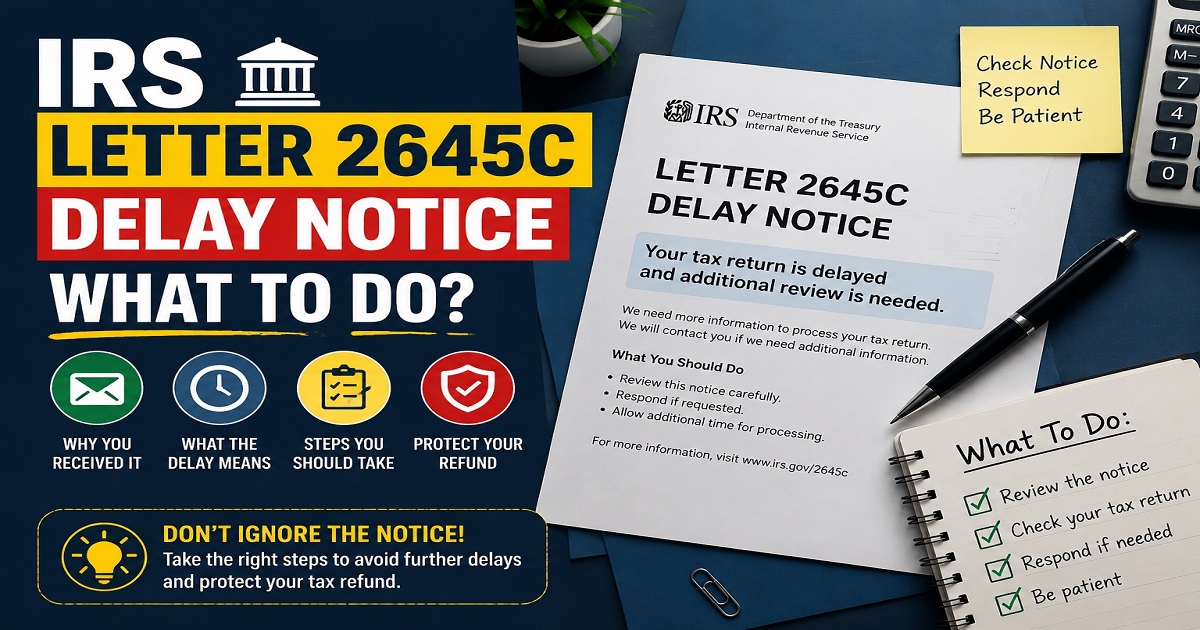
As noted by Advocate Shahid (Tax Legal Research Specialist). The IRS Letter 2645C is an interim tax return “delay notice” indicating the IRS takes longer (usually 60 days) to process your tax return or previous inquiry. It’s not a bill, it’s not an audit notice, but rather it allows the agency to give itself some time to process your case.
IRS Letter 2645C Delay Notice: What It Means
You are being reviewed
The IRS is verifying information in your tax return, for example, income items or credits.
No immediate action is required
If the letter asks for you to send the documents, there is no need to respond to it right away.
More communication to follow
The letter will say they will either send a resolution or another letter within a certain amount of time (typically 60 days).
What You Should Do
Pay attention
If the letter requires you to send specific tax documents or verify your identity, look for the word “specific” in the letter. If it does, then read the instructions carefully.
Hold for 60 days:
In most cases, all you can do is wait for the IRS to finish their review.
Review your online account:
Review your status and communications on IRS Account Dashboard.
Seek professional assistance:
If you are getting several delay notices or if you are struggling to pay your taxes because your refund has been withheld, you may want to consider getting help from a professional or submit a Form 911 for assistance from the Taxpayer Advocate Service.
Understanding IRS Letter 2645C
What is IRS Letter 2645C?
IRS Letter 2645C is an official IRS notification letter that is sent by the Internal Revenue Service (IRS) when there is the need to review your tax matter in detail. It could be a relation to unpaid taxes, payment delays from the IRS, missing information, or any response from the IRS is pending. A John got a 2645C for failing to pay a quarterly tax. In the letter, he expressed concern that it would trigger an immediate bank levy, but the letter primarily indicated that the IRS was still in the process of reviewing his bank account.
Why Did I Receive IRS Letter 2645C?
IRS Letter 2645C might be sent due to unpaid taxes, unpaid taxes, delayed processing or review by the IRS Collection Department. However, it is not always the last enforcement, it may be something that needs to be dealt with. Be sure to read the notice carefully, and verify what the Internal Revenue Service is requesting.
Key Problems and Risks of Ignoring IRS Letter 2645C
Consequences of Inaction
Understanding the IRS Collection Timeline
The IRS process of collection explains the progression of unpaid taxes and federal tax responsibilities that increase over time. When a 2645 notice remains unanswered, the IRS may transition from to administrative actions, like liens or levies. Prompt communication with the IRS Collection Department may help avoid delays from turning into larger monetary fines.
What to Do When You Receive 2645C: Step-by-Step Solutions
Step 1 – Verify the IRS Tax Notice
First, check the accuracy of the IRS tax debt and unpaid taxes listed. Please check all official correspondence item for accuracy and to make sure the notice is real and amounts are correct.
Step 2 – Know Your Taxpayer Rights
Know and understand the Collection Due Process (CDP) rights, taxpayer assistance program, and appeal rights. Understanding these safeguards enables you to react with assurance and avoid unwarranted penalties.
Step 3 – Respond Properly to IRS Letter 2645C
Properly write a letter to IRS using the template. For instance, Maria was contacted by a bank that was planning to file a levy on her account and she responded to it within 15 days and a 2645C was issued, preventing a possible bank levy. Timely and accurate responses are crucial.
Step 4 – Explore Tax Resolution Options
Look into options such as an Installment Agreement, Offer in Compromise, and Currently Not Collectible. Payment plans and relief from penalties are also available with the IRS and can be good options to consider when managing your federal tax burden.
Step 5 – Avoid Common Mistakes
Please do not ignore the notice, miss deadlines, fail to provide complete documentation or pay without checking the amounts. These mistakes may raise the IRS’s red flags.
Real-Life Case Studies & Lessons
Case Study 1: An individual taxpayer was sent the IRS Letter 2645C and responded right away with a Collection Due Process (CDP) request. They acted promptly and didn’t need to have their wages garnished, they were able to negotiate a reasonable payment plan. Lesson: Take timely action using your CDPs to avoid serious enforcement actions.
Case Study 2: IRS notice had a tax debt error due to a system error. The taxpayer has written an informative IRS dispute letter and the IRS corrected the error within a few weeks. Lesson: When reading the notice and providing accurate documentation, errors can be avoided without any repercussions.
How to Stop IRS Levy and Enforcement
Filing an Appeal or Collection Due Process Request
If you do not wish to face IRS enforcement action, you can appeal a determination or request IRS Collection Due Process (CDP) relief. Review your 2645C notice carefully first, collect supporting documents and explain what you don’t agree with regarding your unpaid taxes. Submit request according to the IRS guidelines to start tax dispute resolution. Filing on time can temporarily halt levies, liens or wage garnishments until the IRS has the chance to review your case.
Setting Up an IRS Payment Plan
Another good option is to work out a payment plan with the IRS. Peter was issued a 2645C notice and set up an agreement to pay by the month, for instance, and this put a stop to any further escalation of collection. Payment plans can help taxpayers pay their federal taxes in installments and help them avoid any aggressive enforcement action.
Mistakes to Avoid When Handling IRS Letter 2645C
Here are some common mistakes to avoid when responding to IRS Letter 2645C:
- Not paying after verifying the notice: If you pay without verification of the notice, then you are obligated to pay the taxes.
- Failure to pay on time: If the IRS response dates are not met, wage garnishments, bank levies or other IRS enforcement measures may be issued.
- Lack of documentation: Make sure to include all necessary forms, statements, and documents to back up your disagreement or payment agreement.
- If the delay notice is optional: If the letter appears to be a delay notice, it is official IRS notification and is important to be addressed in a timely manner.
These are important considerations to keep in mind to ensure that you protect your rights, avoid unnecessary penalties and improve IRS tax debt resolution.
FAQs
What is IRS Letter 2645C?
IRS Letter 2645C is a formal letter from the Internal Revenue Service that informs you that taxes have not been paid, a payment has not been received or your account is not processed. It means that your case is under IRS Collection Department’s review.
Why did I receive IRS Letter 2645C?
This letter can be issued as the result of unpaid taxes, non-payment or processing errors. It’s the IRS’s way of notifying taxpayers of issues that are pending and collection actions that might be taken.
How to stop IRS Letter 2645C enforcement?
Collection Due Process (CDP) requests, proper dispute letters or IRS payment plans are ways to stop enforcement of tax collection, putting a halt on tax levies and tax garnishments.
Can I appeal IRS Letter 2645C?
Taxpayers may appeal the amount of the tax and/or the action of the IRS and can do so by using the IRS appeal process or CDP hearing.
What happens if I ignore IRS Letter 2645C?
Failure to respond to the letter can result in bank levies, wage garnishment, and other steps taken by the IRS to enforce the law. Delaying increases the federal tax liabilities.
How long do I have to respond to IRS Letter 2645C?
Application deadlines can differ from one to another but are generally around 15-30 days. Avoid escalating an enforcement procedure by taking the right action at the right time.
IRS Letter 2645C vs 1058 notice: What’s the difference?
Letter 2645C will notify you of pending review or missed payments, and Notice 1058 will generally be associated with specific amounts of tax that are due or penalties. They’re both an issue, but they’re also very different and come with differing priority.
Is IRS Letter 2645C urgent?
It doesn’t necessarily mean that there is a current levy, but it’s a formal notice from the IRS that needs to be addressed in a timely manner to prevent enforcement measures.
Conclusion
A Letter 2645 delay notice is unsettling but one that can be prevented by taking action and taking action based on your own knowledge to avoid serious consequences such as bank levies, wage garnishments or any other action taken by the IRS. To effectively solve a problem, it’s important to thoroughly read the notice and understand the rights of the taxpayer and what may be required to solve the problem, such as filing a Collection Due Process request or establishing an installment agreement or offer in compromise.
Examples of real-life situations demonstrate that early responses and documentation can stop problems from getting out of hand and can help preserve your federal tax liability. Understand why you get late payments, expiration dates, no documentation, no proof of payment and how to handle these situations to remain compliant and not make them worse.
To wrap up, here are some tips that will help you manage IRS tax debt or unpaid taxes without attracting further penalties, and maximize your taxpayer rights: Be proactive, informed and organized.