
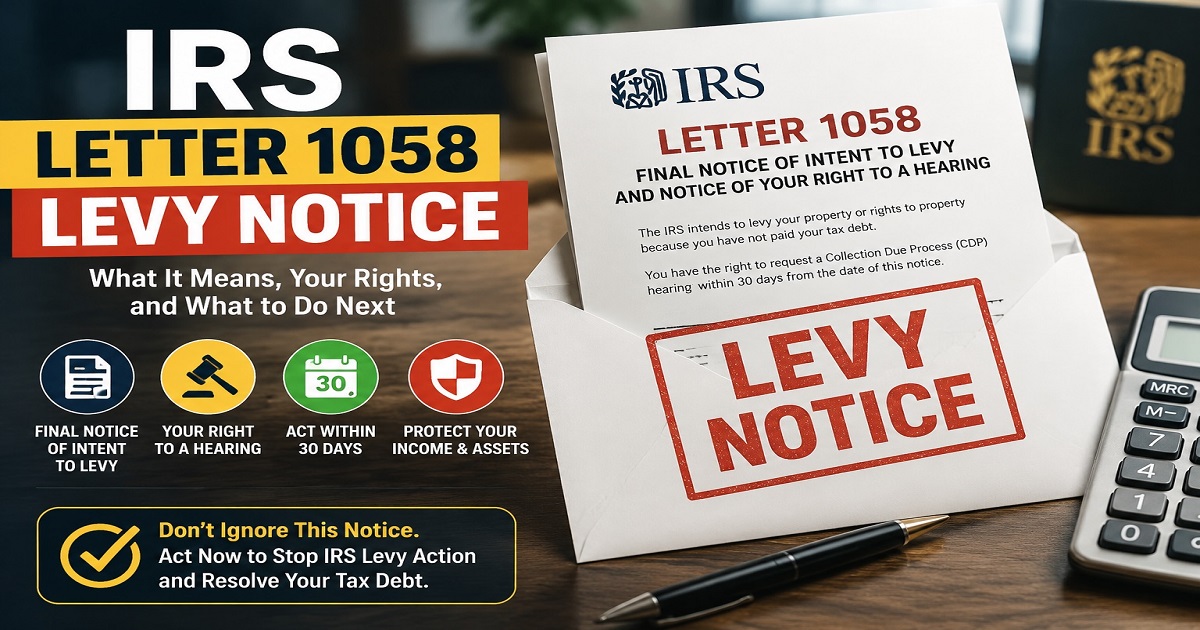
As outlined by Advocate Shahid (Tax Policy and Advisory Specialist). The IRS Letter 1058 is not a routine letter, it is a serious IRS Collection Letter. If you received an IRS 1058 notice, the IRS thinks you have an unpaid tax balance and is sending you a final notice from IRS that they will be placing a tax lien on your IRS tax debt if it is not paid. A levy is not a lien: The IRS says that a lien is a legal claim against property, but a levy is a legal seizure of property.
In layman’s terms, the IRS can seize wages, bank deposits, property or some federal payment to recover the tax debt in Letter 1058 IRS. This is a general tax collection rules notice from the IRS, and is not a legal or tax advice.
What Is IRS Letter 1058?
The IRS Letter 1058 is an official IRS last chance notice of intent to levy. It is often referred to as “Final Notice – Notice of Intent to Levy and Notice of Your Right to a Hearing.” In other words, the IRS Letter 1058 meaning is that the IRS thinks that you are further behind with your taxes and are alerted to the fact that if you do not pay your debt, dispute it, or resolve it, the IRS will use a levy to collect its unpaid tax.
The very act of the IRS issuing a Notice of Intent to Levy should not be taken lightly as it is near the enforcement phase of the IRS collection process. According to the Taxpayer Advocate Service, Letter 1058 is typically sent by a Revenue Officer and is normally required prior to IRS taking a levy, however, there is an exception for legal reasons.
For instance, a self-employed individual may fail to pay the 2022 taxes in response to a number of IRS tax collection letters. These are then sent to them by certified mail in the form of Letter 1058 IRS. This is not to say that the IRS has already gotten the money, but it does mean that the IRS is much closer to wage garnishment, bank levy or any other means of collecting the money. The Notice of Your Right to a Hearing is also a very important opportunity for the taxpayer to challenge or resolve the proposed levy prior to it being implemented.
Why Did You Receive IRS Letter 1058?
I got an IRS Letter 1058, what does it mean? It is typically received when the IRS has determined a tax shortfall, sent out previous bills and displays an unpaid tax shortfall on the account. In other words, the IRS thinks that you have unpaid, disputed or unpaid overdue federal taxes or back taxes.
Your tax liability notice may have gotten further along in the IRS collection process by the time you receive it. The notice could be from a Revenue Officer or via IRS collection methods. The Taxpayer Advocate Service says that Letter 1058 is issued when a balance hasn’t been resolved and the IRS is still pursuing for collection.
IRS Letter 1058 is sent to many taxpayers who have ignored previous notices from the IRS and put off. It isn’t just the unpaid tax debt that’s the real problem. The issue with the IRS payment demand is that if the tax payers don’t respond on time, the IRS will have a legal avenue to collect the taxes and will be able to enforce it with a levy. Normally, the IRS notice of intent to levy is a warning that the IRS will levy the amount if it is not paid within 30 days.
Is IRS Letter 1058 Serious?
Yes, IRS Letter 1058 is serious, as it is an IRS levy warning letter and is typically issued as a last notice prior to any actions of a levy. It’s not just a reminder to pay your unpaid taxes. It means it’s a sign that IRS is gearing up for IRS action if the tax balance is not paid, appealed or resolved.
The IRS will most likely issue a levy only after it has assessed a tax, sent a notice and demand for the tax to be paid, the taxpayer has failed or refused to pay, and the IRS has sent a Final Notice of Intent to Levy and Notice of Your Right to a Hearing at least 30 days before the levy. This notice can be delivered by personally serving the notice, mailing it by certified or registered mail to the taxpayer’s home or business address or mailing it to the taxpayer’s last known address.
Many taxpayers find that their IRS issue turns from paperwork to a threat to their wages, bank account or business operation when the IRS sends Letter 1058. An IRS final notice urgent response is important because this IRS tax levy notice is a step closer to actual tax enforcement.
What Can the IRS Levy After Letter 1058?
What does the IRS do when they get to Letter 1058? Once notice and levy requirements have been met, the IRS will seize many different types of income, accounts and property for unpaid tax debt. This can include a levy on a bank account, Wage Garnishment by the IRS, property seizure, tax refund levy or even a Social Security or Federal payment levy, to call a couple of of the various types of levies.
According to the IRS, a levy can be placed on wages, retirement accounts, dividends, bank accounts, licenses, rental income, accounts receivable, the value of a life insurance cash loan, commissions, and physical property like a car, boat or house.
| Possible IRS Levy Target | What It Means | Common Risk Level |
|---|---|---|
| Bank account | IRS may take funds from an account after proper levy steps | High |
| Wages | Employer may be required to send part of wages to IRS | High |
| Tax refund | Future refund may be applied to tax debt | Medium |
| Accounts receivable | Business customer payments may be redirected to the IRS | High for businesses |
| Property | IRS may seize and sell certain property | Less common but serious |
| Federal payments | Some federal payments may be levied | Depends on case |
An IRS bank levy can cause immediate cash flow issues, and an IRS wage levy can proceed every pay period until the debt is paid off, cancelled or otherwise disposed of. Business owners can be particularly affected by accounts receivable levies as customers could be diverted to a different entity prior to paying the business.
IRS Levy vs Federal Tax Lien: What Is the Difference?
The short answer to the question of federal tax lien vs. levy is that a tax lien is a legal claim, and a tax levy is the taking of the money or property. According to the IRS, a federal tax lien is the legal claim of the government to your property to get the tax debt paid, and a federal tax levy is the legal seizure of property to collect the tax debt.
If you receive a tax collection notice with a tax lien, it is probably the IRS is safeguarding its interest in the property. A levy notice is more imperative, because the IRS may not be claiming rights, but collecting. That is why it is not a lien, but rather proposed levy action, in Letter 1058.
For instance, a lien is a simple statement, “we have a legal claim,” by the IRS. A levy is similar to the IRS stating “We are taking money or property in order to meet the tax debt obligation.
It is important to know what your levy rights are, because the IRS will typically provide you with the right to request a hearing prior to levy action in IRS Letter 1058. This is a crucial procedure in IRS tax debt settlement as it can provide you with the time to appeal, propose a payment plan, contest the tax debt, or request a different IRS collection option.
How Much Time Do You Have to Respond to IRS Letter 1058?
What’s the deadline for IRS Letter 1058? For most of the time, the IRS Letter 1058 deadline is to be interpreted as a “30-day” deadline, but always be sure to consider the actual date on the notice. If the taxpayer thinks the levy is inappropriate and receives Letter L-1058 or LT11, he or she should have 30 days from the date of receipt to request a Collection Due Process hearing by completing Form 12153, the IRS says.
It is important to file the CDP request in a timely written manner as it will maintain more rights of appeal to the IRS after the levy is filed. The Taxpayer Advocate Service will also remind taxpayers that the deadline as stated on Letter 1058 cannot be extended, and an untimely request may only be entitled to an Equivalent Hearing, as this does not afford the same rights of the Tax Court.
The notice will be sent to your last address by certified or registered mail – don’t ignore it because you missed it or it was late.
Note: DO NOT wait until the last day. A Call to IRS does not constitute a written CDP Request. Send Form 12153 by mail, fax or submit in accordance with the directions in the notice and retain a copy of the notice of the action taken.
How to Appeal IRS Letter 1058
What can you do if you receive IRS Letter 1058? Yes. An IRS letter 1058 appeal typically involves an appeal to the IRS Independent Office of Appeals (IOA) for a Collection Due Process (CDP) hearing. There is a reason these IRS appeal rights are important: If you make an appeal in time, it could stop or delay the levy process until the case is resolved.
Step 1 — Confirm the Notice Is Real
Look for the IRS notice number, tax year, IRS address, amount due and any Revenue Officer contact information. The Taxpayer Advocate Service urges taxpayers to be sure the letter is from the IRS and follow the instructions carefully.
Step 2 — Read the Deadline
Locate response deadline/notice date as soon as possible. Taxpayers have 30 days from the date on the notice to request a CDP hearing, generally, the IRS says.
Step 3 — Decide Whether You Need a CDP Hearing
There is a chance to appeal the proposed levy action through the IRS Independent Office of Appeals, with a CDP hearing. That’s why IRS levy notice appeal rights clarified is crucial: you can challenge the IRS collection options, IRs qualifying issues and disagreement with IRS proposed levy.
Step 4 — Complete Form 12153
Apply for IRS CDP hearing IRS appeal using IRS form 12153. The Taxpayer Advocate Service provides information about Form 12153, which can be used to ask for a CDP or equivalent hearing when certain notices of collection are sent by the IRS, such as a Final Notice of Intent to Levy.
Step 5 — Include Collection Alternatives
On the form, you have to provide any information to the IRS that you’re wanting them to take into account. This could mean an installment agreement, offer in compromise, currently not collectible status, penalty abatement, or any other tax debt resolution. In IRS appeal guidance, it is noted that it is important to look for all points of disagreement.
Step 6 — Send It to the Correct Address
Please return to the address on your levy notice the completed Form 12153. Only send it to an IRS address that is listed in the notice.
Step 7 — Keep Proof
Retain receipts from certified mail, fax, upload and a copy of all correspondence sent. Evidence of submission can be quite crucial in the event of a later dispute concerning timeliness of the appeal.
What Is a Collection Due Process Hearing?
What is Collection Due Process? An IRS appeal process called a CDP hearing that provides a taxpayer with an opportunity to appeal a proposed collection action before the IRS Independent Office of Appeals. This typically involves the taxpayer taking advantage of his/her levy rights to request Appeals to consider an appropriate levy.
IRC 6330 provides the legal structure for CDP rights, and Internal Rev. Code Sec. 6331 provides authority for the IRS to levy for delinquent taxes. The IRS states that, as a general rule, they will provide a Final Notice of Intent to Levy and Notice of Your Right to a Hearing 30 days before initiating levy action.
A CDP hearing may be held to consider the alternative methods of complying such as installment agreements, offer in compromise or other methods of resolution. IRS CDP FAQs explain that for people who don’t have the ability to pay the balance in full, they need to fill out Form 12153 and might need to submit financial data, which can be in the form of Form 433-A for individuals or Form 433-B for businesses.
It’s a very common piece of advice among tax experts to take the request in an organized, rather than emotional fashion. A more robust CDP request will typically consist of notice, proper tax periods, financial documents and an outlined solution. This provides Appeals with an opportunity to determine what the taxpayer wants, and why the proposed levy should be postponed.
What If You Miss the 30-Day Deadline?
You might still have options if you miss the 30-day deadline, but they may not be as strong as if you make your Collection Due Process request in a timely fashion. How many days will it take for taxpayers to respond to IRS Letter 1058? If you can, do it within three months of the date of the notice; the safest answer, however, is to follow the deadline that is printed on the notice.
If a late CDP request is received, it can be considered a hearing request. When a timely request is made, IRS action on the levy is normally halted for the tax periods being appealed, and the taxpayer can petition the Tax Court for a review if they disagree with Appeals. The taxpayer does not have the same right to Tax Court review of a request for a CDP Equivalent Hearing if made outside the time limit.
The practical risk is also described in Publication 1660; an equivalent hearing does not prevent the collection of a levy, it does not extend the collection statute and it does not allow for the taxpayer to go to court in case of a disagreement with the Appeals decision.
So what do I do if I don’t respond to IRS Letter 1058? The IRS may persist in their efforts to collect, such as through a bank levy, wage levy or other means. Failure to pay or file does not automatically mean that IRS collection action cannot be halted after mailing of Letter 1058, it can just make the case more difficult to successfully appeal and increase the taxpayer’s appeal rights.
Can You Stop an IRS Levy After Letter 1058?
Yes, it is possible to take action after IRS Letter 1058 to prevent further IRS levy action, but soon. Depending on your reasons for disagreement with the tax, you might need more time, can’t afford to pay it, or think that your IRS account is incorrect, the right solution is different. If a levy is already disruptive of one’s immediate financial survival, the IRS encourages taxpayers to reach out to the IRS immediately and a levy could be removed if it makes it difficult to afford basic and reasonable living expenses.
Request a Timely CDP Hearing
When you disagree with the levy or need time to come up with a solution, it can often be one of the best ways to respond to a CDP hearing request in a timely manner. This may help preserve the appeal rights that you have during the pendency of the proposed IRS collection action.
Set Up an Installment Agreement
If you can only pay monthly, but cannot pay the balance at this time, then you may be eligible for an installment agreement. The IRS rule is that they will not levy an income taxes while a request for an installment payment plan is pending, except in certain situations.
Submit an Offer in Compromise
An offer in compromise can be beneficial if you are not able to pay the entire tax debt or you would have financial hardship from doing so. The IRS takes into account ability to pay, income, expenses and asset equity when accepting an offer.
Request Currently Not Collectible Status
When a person’s tax bill is due but cannot afford to pay the taxes or other essential bills, they might require IRS levy notice assistance. If the IRS is to issue a levy, the debt to the government does not go away, even though it may cause economic hardship.
Pay the Balance in Full
When you can, it is typically the quickest tax debt solution that you’ll have since the debt is taken care of right away.
Correct IRS Account Errors
If IRS bank levy or IRS wage garnishment are not necessary due to IRS having the wrong balance, missing payment, unprocessed amended return, or the wrong tax period, please try to seek IRS bank levy help or help to stop IRS wage garnishment. Correcting account mistakes in a timely fashion can avoid additional levy action.
Payment Options After IRS Letter 1058
Once IRS Letter 1058 has been received, it is crucial to find a solution to the IRS tax debt issue before it becomes a bigger issue due to levy action. The answer will vary according to your income, assets, filing status and your hardship and whether the IRS has the balance right. What is perfect for one person isn’t necessarily perfect for other people. An IRS payment plan after IRS levy notice might suit one person’s needs, but not another’s. An offer in compromise after IRS levy notice or IRS currently not collectible status may suit one person’s needs, but not another’s.
| Option | Best For | Main Requirement |
|---|---|---|
| Full payment | Taxpayer can pay now | Pay balance, penalty and interest |
| Installment agreement | Taxpayer can pay monthly | Current tax filings and ability to pay |
| Offer in compromise | Taxpayer cannot fully pay | IRS financial review |
| Currently not collectible | Taxpayer has hardship | Proof of income, expenses, assets |
| Penalty abatement | Reasonable cause or first-time relief | Supporting explanation and documents |
If a taxpayer is able to pay IRS back taxes over time, then an installment agreement following IRS Letter 1058 may be of assistance. Generally, the IRS does not allow them to levy during an installment agreement request, unless there are some exceptions, according to the IRS.
An offer in compromise is a type of IRS tax debt settlement that can be made to the IRS if the taxpayer qualifies that allows them to settle for an amount that is less than what is actually owed. The IRS considers if a taxpayer can pay, income, expenses and asset equity before accepting an offer.
Currently not collectible status is helpful if a taxpayer can’t afford to pay living expenses and taxes. Any penalties or interest will be due and payable as normal, and the debt will not be cancelled. The Internal Revenue Service (IRS) might not collect the taxes, but penalties and interest will still apply, and the debt will not be forgiven.
Real Case Laws That Help Explain IRS Letter 1058 and CDP Rights
Taxpayers can better understand the need to act quickly, structure a response to a Letter 1058 and focus their efforts on legal matters through the use of case law. The cases are not precedents to follow when litigating a Collection Due Process dispute with the IRS, but they are examples of how courts have heard cases involving Collection Due Process disputes and IRS levy actions.
Goza v. Commissioner — You May Not Always Be Able to Challenge the Tax Debt
The taxpayer in Goza v. Commissioner, 114 T.C. 176 (2000), had already received a notice of deficiency, but failed to timely file a petition in the Tax Court. Later, in the CDP process, he sought to challenge the tax liability. The Tax Court found that he was barred from attacking the liability, since he had had a prior opportunity to contest the liability. This case is good to include because it provides an explanation of one of the important rules of the CDP: that some taxpayer may have the option of trying to contest the amount they owe, while others may only have the option of collection alternatives like offer in compromise or hardship relief or an installment agreement.
Robinette v. Commissioner — CDP Review and Abuse of Discretion
In Robinette v. Commissioner, 439 F.3d 455 (8th Cir. In the 2006 case, the taxpayer’s grievance was against the IRS’s treatment of an offer as defaulted, as well as an offer of compromise. In 2006, the taxpayer’s grievances centered on an offer of compromise and whether or not the IRS Appeals office abused its discretion in allowing collections to continue after the taxpayer defaulted an offer. The Tax Court erred in its findings, and the Eighth Circuit resolved the issue and ruled in favor of the Appeals officer. In IRS Letter 1058 cases, Robinette demonstrates that there is more to Appeals review than sympathy or hardship—there must be something that is legally and factually acceptable for which the proposed levy ought to be reconsidered.
Mesa Oil, Inc. v. United States — Businesses Can Use CDP to Raise Payment Alternatives
In Mesa Oil, Inc. v. United States, 467 F.3d 1252 (10th Cir. In 2006, a business was confronted with collection of employment tax and corporate tax debts. The company discussed penalty abatement, additional time to pay or pay in installments during the CDP process. But this business-oriented case study demonstrates that a CDP hearing can be more than just the question of whether I owe the tax. It might also concern whether IRS had taken into account collection options before proceeding with the action on a levy.
Real-Life Case Study Examples
Case Study 1 — Employee With IRS Wage Levy Risk
A W-2 employee is sent a letter by IRS (letter 1058) for $14,000 in back taxes. He is concerned about the possibility of IRS enforcement action, such as the wage levy, because of the notice and he has a low income and is unable to do the full balance, however he can afford to pay the monthly payments. He submits Form 12153 before the deadline, files for a CDP hearing, files Form 433-A and offers an installment agreement.
Lesson: Acting before the deadline can help prevent wage garnishment by IRS.
Case Study 2 — Business Owner With IRS Bank Levy Risk
A small business owner gets a notice to pay with a notice of intention to levy.A small business owner is served with a NOI and NOL. The IRS Revenue Officer asks for the money to be paid immediately, while the business needs cash to pay employees, rent and vendors. The owner is quick to respond, and ready to make financial records and offers to go on a structured payment plan.
Lesson: Don’t wait, as an IRS bank levy could have a negative impact on cash flow.
Case Study 3 — Taxpayer Who Missed the Deadline
A taxpayer fails to comply with Letter 1058 for two months. Later they ask for assistance but the 30 day CDP has expired. They might still demand an equivalent hearing, but do not have as much protection.
Appeal Rights: Due to the deadline, appeal rights may be limited.
Common Mistakes to Avoid After Receiving IRS Letter 1058
Once IRS Letter 1058 is received, minor errors can escalate into a big IRS compliance problem. It is linked with tax enforcement and should be quick, structured and backed up with records.
Some of the errors to be avoided are:
- Not complying with the notice because there has been no payment made yet.
- Calling the IRS, but not filing Form 12153 when it is important that appeal rights be taken advantage of.
- Not submitting the 30-day levy appeal in time.
- Filing the form on the incorrect IRS address.
- Forgetting to include the correct tax years and tax periods.
- Offering to pay in installments, without filing missing tax returns.
- Unrealistic OIC offers without funds.
- Failure to retain a receipt for certified mail or fax confirmations or proof of submission.
- Misidentifying a federal tax lien for an IRS tax lien. Misidentification of a federal tax lien as an IRS tax lien.
- Allowing a bank levy or wage levy to occur.
These errors can lead to higher penalty and interest costs, reduced rights to appeal and making IRS collection defense more complex. When the notice relates to a large balance, business taxes, payroll taxes or immediate levy risk, it is imperative to consult with a competent tax professional to discuss IRS notice issues. An appropriate response can help prevent income loss, bank fund loss and resolution options.
IRS Letter 1058 vs LT11 vs CP90
The similarity between the IRS Letter 1058 vs LT11 and IRS Letter 1058 vs CP90 notice generally lies in the way that the IRS notifies the final levy warning. All three notices may alert the IRS to its intent to levy on unpaid taxes, and may provide the taxpayer with Collection Due Process appeal rights. It’s important to read the notice exactly as it is written, including the deadline, tax periods, and instructions on how to respond.
| Notice | Main Meaning | Appeal Right |
|---|---|---|
| IRS Letter 1058 | Final notice of intent to levy, often connected with Revenue Officer cases | CDP hearing request may be available |
| LT11 / Letter 11 | Final Notice of Intent to Levy and Notice of Your Right to a Hearing | IRS says Form 12153 should be filed within 30 days |
| CP90 | Final Notice, Notice of Intent to Levy and Notice of Your Right to a CDP Hearing | IRS says Form 12153 should be filed within 30 days |
The IRS identifies the following notices as ones that provide appeal opportunities: Letter 1058, Letter 11 and CP90. If a taxpayer wishes to appeal the proposed levy action, they need to submit Form 12153 within 30 days of the date of the letter or notice to the IRS’ address listed on the levy notice.
All IRS 1058, final notices, LT11 and CP90 are documents that should be handled as if they were a levy warning. The title is somewhat different, but it is all about taking action immediately, preserving the rights to appeal, and settling the tax debt before collection takes further action.
When Should You Contact a Tax Professional?
Should I use IRS Letter 1058 tax attorney? While not everyone will require one, it is wise to have professional assistance when there are urgent deadlines, large amounts of tax owed, business taxes, and/or potential levy action. An IRS Letter 1058 tax attorney, CPA, or enrolled agent will be able to review the Letter, prepare the IRS Form 12153, organize financial statements, and communicate with IRS.
If you receive an IRS notice, you may want to contact an IRS levy attorney, IRS enrolled agent IRS levy help, or other tax professional to get some assistance in helping you with your IRS notice, include:
- The 30-day period is soon over.
- You have already been contacted by an IRS Revenue Officer.
- You have a number of years of federal tax debt.
- You’re paying the wrong amount of payroll taxes.
- A levy on your bank was issued or a wage levy was issued.
- You wish to submit an offer of compromise.
- You think that the balance on the IRS is incorrect.
- Assistance is required with preparing Form 12153 or financial statements.
According to the IRS, attorneys, CPAs, and enrolled agents are generally authorized to represent taxpayers before the IRS and Form 2848 is where they approve to represent you. Professional help can be valuable for serious IRS collection defense as it will help safeguard appeal rights, review tax relief when receiving a levy notice from the IRS, and select the most favourable strategy to resolve the tax debt.
Frequently Asked Questions
What is IRS Letter 1058?
IRS Letter 1058 is a final notice of intent to levy and notice of your right to a hearing. It implies that the IRS could take enforcement measures if you don’t settle your outstanding taxes. In the IRS page for LT11/Letter 1058, it has been explained that the IRS can levy property which includes wages, bank accounts, business assets, personal assets, state tax refunds and some payments from the federal government.
What does IRS Letter 1058 mean?
It indicates that the IRS thinks there is federal tax debt and that it is alerting you that it will take steps to collect that debt. Also provides appeal information. A levy, unlike a lien, is a legal action by the IRS to collect a tax debt.
How long do I have to respond to IRS Letter 1058?
Carefully read the exact date on your notice. When IRS appeal guidance refers to 30 days to appeal a final levy, it is usually to challenge it by filing Form 12153 with IRS for a Collection Due Process hearing. In addition to that, the Taxpayer Advocate Service says that CDP requests are usually filed within 30 days of the date of a notice of intent to levy.
Can I appeal IRS Letter 1058?
Yes, if you make a request within the correct time frame, you can hold a Collection Due Process hearing on Form 12153. TAS states that Form 12153 is a request for a CDP or similar hearing after a number of notices are issued including a Final Notice of Intent to Levy.
How do I stop an IRS levy after Letter 1058?
There are ways to prevent or delay levy action, such as requesting a timely CDP hearing, establishing an installment agreement, paying the balance, fixing IRS errors, requesting currently not collectible status or filing an offer in compromise. If the IRS has already issued a levy, then IRS states a levy can be released in case it is in error or if it brings instant economic hardship.
Can the IRS levy my bank account after Letter 1058?
Yes, if the law is followed and if the situation is not addressed, then the IRS can levy bank accounts or other property rights. According to the IRS, a levy can attach to wages, garnish a financial or bank account, and lay claim to and sell vehicles, real estate and other personal property.
What is Form 12153 used for?
If you receive some collection notices from the IRS, you can have a Collection Due Process hearing or equivalent hearing by filing Form 12153. When a notice is issued to taxpayers, authorized representatives, or third parties whose property is subject to collection action, taxpayers are able to file Form 12153 to request a hearing or CDP.
Can I set up a payment plan after IRS Letter 1058?
Absolutely, many individuals apply for an installment agreement or other collection option following a collection notice. IRS and TAS guidance provides information about the steps involved in collection alternatives in CDP or equivalent hearings and about financial information taxpayers must submit in requests for relief or payment arrangements.
Conclusion
IRS Letter 1058 Levy Notice explained: This is NOT a notice to ignore. This is a legitimate IRS levy notification and generally is about unpaid tax debt, potential enforcement action and your IRS appeal rights. The deadline and instructions for responding to the final notice of intent to levy are significant because it is a final notice of intent to levy.
The four key actions are to confirm the notice, review the tax years and balance, see the tax response deadline and determine if a Collection Due Process hearing is necessary. The right IRS tax debt resolution process from there can be an installment agreement, offer in compromise, currently not collectible status, penalty relief, correcting IRS account errors or paying the balance in full.
It is better to act early for more control. It might help you prevent the IRS from taking any collection action that affects your income, business or financial stability before it’s an IRS bank levy, IRS wage levy, or IRS levy action.